Care & repair guide
Quartz vs Granite vs Porcelain Worktops
There is no best worktop material — there is a best material for how you cook, what you want it to look like, and where it is going. Here is the honest comparison.
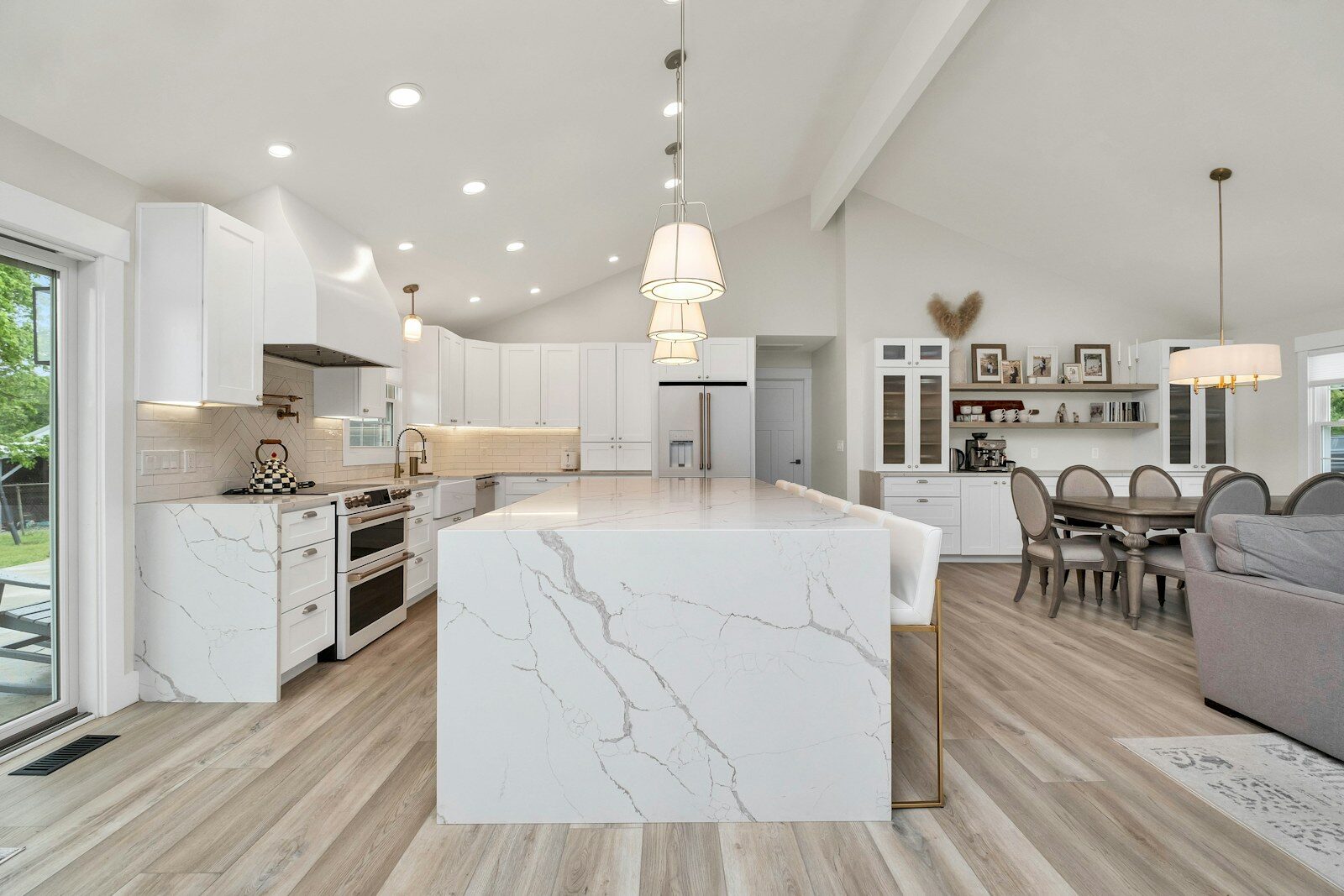
Quartz, granite and porcelain account for nearly every worktop we cut at our West Molesey workshop, and we are asked to referee between them every week. The truthful answer is that all three are excellent and the right choice depends on priorities: heat tolerance, maintenance appetite, budget, looks, and whether the worktop is going anywhere unusual — outdoors, say, or onto a sunny south-facing island.
This guide compares them property by property, with the trade-offs stated plainly — including the ones suppliers tend to soft-pedal. We fabricate and fit all three materials (and marble, which gets its own verdict at the end), so we have no horse in the race: whichever you choose, it goes through the same CNC machinery and the same laser templating. Prices below are our 2026 supplied-and-fitted guide bands — the full cost breakdown lives here.
What actually is the difference between quartz, granite and porcelain?
Granite is natural stone, sawn from a quarried block — every slab unique. Quartz is engineered: around 90% crushed natural quartz bound in polymer resin with pigments, made in consistent, repeatable designs. Porcelain (including branded sintered surfaces like Dekton) is a dense ceramic, fired at extreme temperature into large thin slabs.
Almost every practical difference flows from those three constructions. Granite behaves like rock: hard, heatproof, slightly porous, one-of-a-kind. Quartz behaves like stone-plus-plastic: non-porous and uniform, but with a resin component that dislikes heat and UV. Porcelain behaves like super-ceramic: impervious to heat, sun and stains, extremely hard on the surface, with the character and limitations of a manufactured slab.
Which is the most durable worktop material?
For everyday durability — knocks, scratches, stains, life — quartz and granite are effectively tied, and both will outlast the kitchen around them. Porcelain is the most scratch- and wear-resistant surface of all, but its thinner slabs are less forgiving of hard point impacts on edges and unsupported spans.
In practice: granite and quartz at 20–30mm shrug off dropped pans and chopping directly on the surface (though knives dull). Porcelain at 12–20mm has a surface harder than steel, but a heavy cast-iron pan dropped squarely on an edge or cut-out corner can chip it more readily — mitigated by good fabrication and support, which is where our own CNC workshop and experienced fitting earn their keep. All three are repairable; see our chip and crack guide.
Which worktop handles heat best?
Porcelain wins outright — you can set hot pans directly on it without harm. Granite is close behind: brief contact with hot cookware rarely troubles it, though repeated extreme heat in one spot can stress any natural stone. Quartz is the one that genuinely needs trivets: sustained heat above roughly 150°C can scorch or crack its resin.
The quartz caveat is not a deal-breaker — millions of kitchens use trivets without thinking — but it is real, and thermal cracks beside hobs are the most common quartz damage we repair. If you are a pan-straight-from-the-flame cook, or you are speccing an outdoor kitchen or a worktop around a range cooker, weight this question heavily toward porcelain or granite.
Which materials cope with sunlight and outdoor use?
Porcelain and granite are fully UV-stable and frost-tolerant — both are proven outdoors. Quartz is not: UV degrades its resin, yellowing whites and fading colours, so almost no quartz brand warrants exterior use, and we do not fit it outside. That includes indoor spots in relentless direct sun, like a south-facing island under a glass roof.
This is the quiet spec question people miss. For outdoor kitchens, barbecue surrounds and garden stonework, porcelain's combination of UV-stability, zero porosity (no staining from rain-borne dirt or spilled marinades) and heat-proofness makes it our default recommendation, with granite the characterful natural alternative. Indoors, under normal glazing, all three are fine — modern window glass filters most UV.
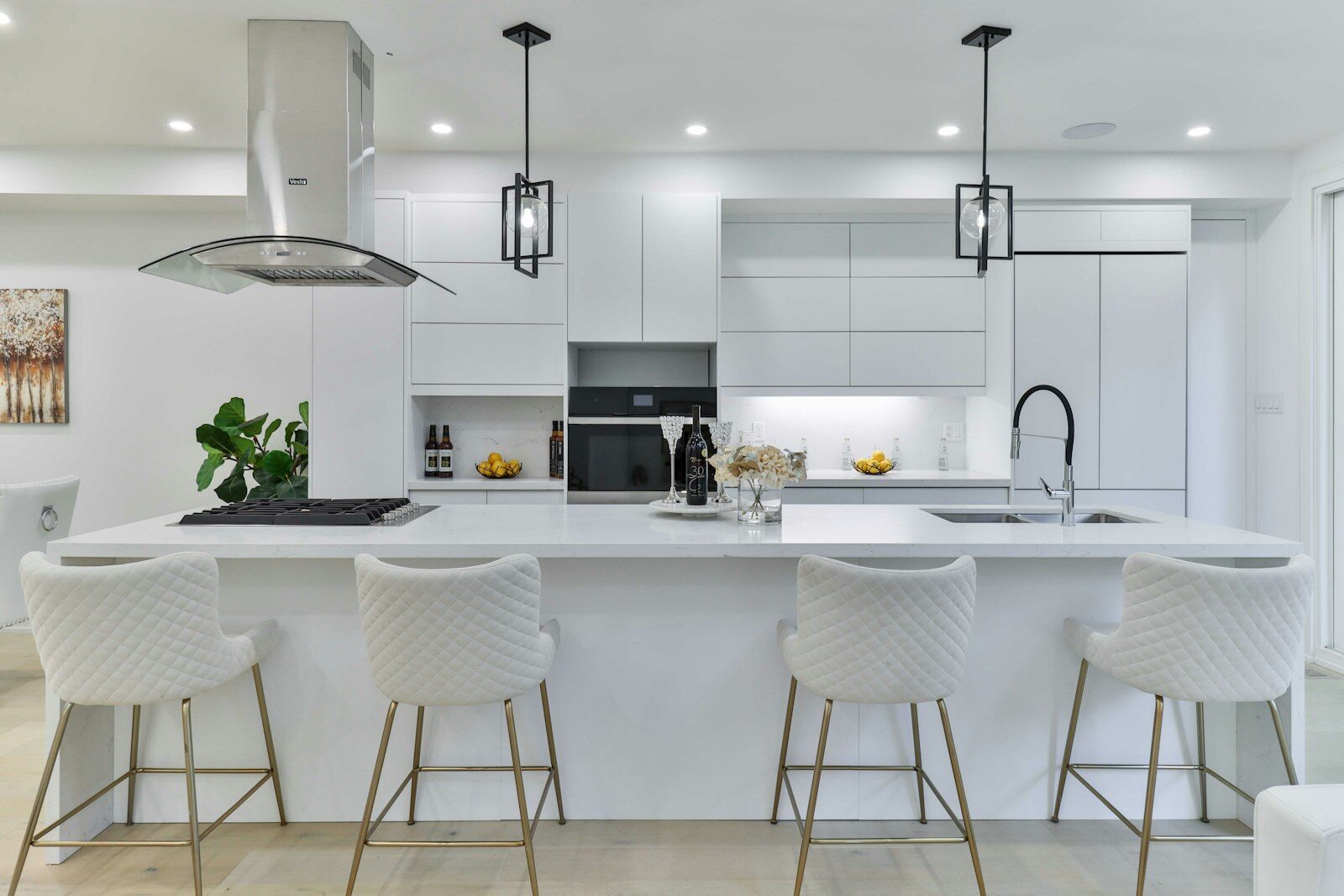
Which needs the least maintenance?
Quartz and porcelain tie for lowest maintenance: both are non-porous, never need sealing, and clean with warm soapy water forever. Granite asks only slightly more — an impregnating sealer topped up roughly every one to three years, tested with a simple water drop, and the same neutral cleaning.
None of the three is remotely demanding; the maintenance gap between them is a few minutes a year. The real divide is with marble and other calcium stones, which etch on contact with acids regardless of sealing. If "wipe and forget" is the brief, any of the big three delivers it — choose on heat, looks and budget instead, and keep stain know-how bookmarked for the rare exception.
How do the looks compare — honestly?
Granite gives you genuine, unrepeatable natural pattern — movement, depth and minerals that catch the light — in mostly mid-to-dark palettes, with lighter options rarer. Quartz gives you designed consistency: reliable whites, greys and convincing marble-look veining that natural stone cannot supply at the price. Porcelain prints its pattern, from plain concrete-looks to dramatic book-matched "marble".
Two honest caveats. Quartz veining, from brands like Silestone and Caesarstone, is excellent at normal viewing distance but reads as manufactured up close against real marble. Porcelain's pattern is on and just below the surface, so a cut edge can reveal a plainer body — managed with mitred edges, which good fabrication plans for. See all three in your own light before deciding: free samples here.
What do quartz, granite and porcelain cost in 2026?
Our supplied-and-fitted guide bands per m²: quartz £250 (Essential) / £320 (Premium) / £420 (Luxury); granite £280 / £350 / £460; porcelain £300 / £380 / £480. A typical kitchen lands between £1,500 and £4,500 all-in, with fitted kitchens from £1,150 — guide only; the exact fixed price follows the free laser template.
Entry-level quartz is usually the cheapest route into stone, popular granites undercut premium quartz, and porcelain carries a fabrication premium because cutting and mitring it demands more from the workshop. Cut-outs, upstands and splashbacks and waterfall ends move the total more than the material band does. The 60-second estimator prices your actual layout in all three materials — and we beat any written like-for-like quote.
And when does marble still win?
Marble wins on beauty, full stop — no quartz pattern or porcelain print fully captures real Calacatta depth — and it wins in low-abuse settings: bathrooms and vanities, fireplace surrounds, console and furniture pieces, and kitchens whose owners accept patina as character.
Choose marble with open eyes: it etches, it needs sealing, and a busy family kitchen will mark it. Plenty of our clients know all that and choose it anyway, usually honed — and they are right to, because nothing else looks like it. The pragmatic hybrid we often build: quartz or porcelain on the working runs, marble on the island or bar where it is seen, touched and admired but not scorched.
FAQ
Your questions, answered.
Which material do you personally fit most?+
Is one material better for resale value?+
Can I mix materials in one kitchen?+
Are thin 12mm porcelain worktops strong enough?+
Do any of these materials harbour bacteria?+
How do I actually decide?+
Related reading
Quartz Worktops
Engineered consistency, from £250/m² fitted.
ReadGranite Worktops
One-of-a-kind natural slabs, from £280/m² fitted.
ReadPorcelain & Dekton
Heatproof, UV-stable, indoors and out.
ReadMarble Worktops
When only the real thing will do.
ReadWorktop Costs Guide 2026
Every price band and extra, explained.
ReadFree Samples
Up to three materials, delivered to your door.
Read
Ready to price your worktops?
Get an instant guide estimate online, or talk it through with the workshop.