Throughout the home
Kitchen Worktops
Quartz, granite, marble and porcelain kitchen worktops, laser-templated and cut on our own CNC machinery. Kitchens from £1,150, fitted in 7–10 days.
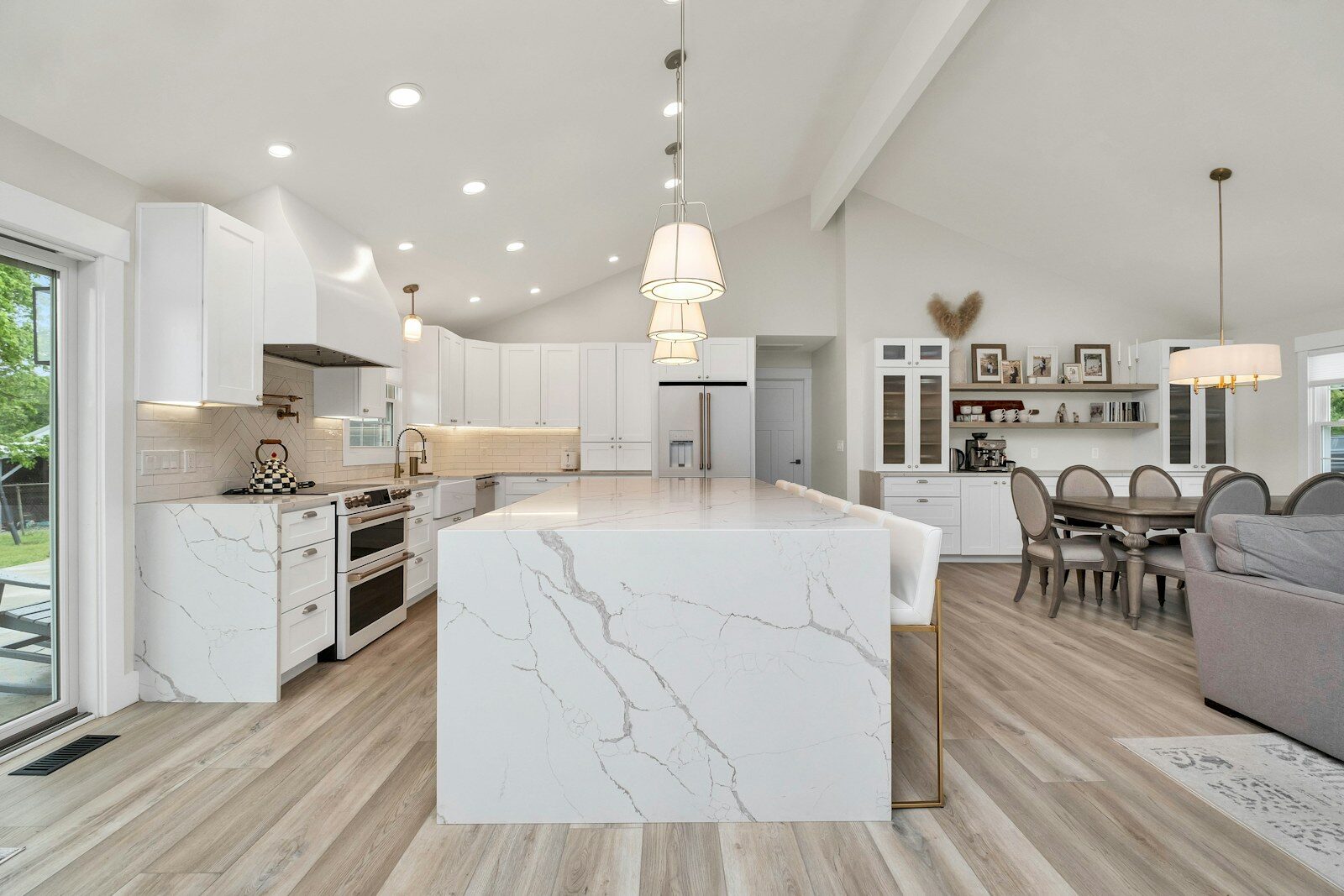
A kitchen worktop is the most hard-working surface in the house, and the one everybody touches, wipes and looks at every single day. Get the material, the template and the fit right and the kitchen feels finished for twenty years; get any of them wrong and you live with the gaps, lips and stains forever. Since 2011 we have supplied and fitted stone worktops across Surrey and South West London from our West Molesey workshop, cutting every job in-house on our own CNC sawing and polishing machinery.
That in-house fabrication matters more than any brochure. We buy A-grade slabs, laser-template your kitchen ourselves, cut to the template on CNC machinery, and send the same team to install — so there is nobody to blame but us, and nothing lost between a showroom, a subcontracted fabricator and a fitting crew. It is also why we can price keenly: kitchen worktops start from £1,150 fitted, and we beat any written like-for-like quote.
This guide covers what Surrey kitchens actually pay in 2026, how to choose between quartz, granite, marble and porcelain, and what happens between ordering and cooking your first dinner on the new surface.
How much do new kitchen worktops cost in Surrey?
Fitted kitchen worktops start from £1,150 with us, and a typical Surrey kitchen — around 4–6 linear metres of run plus a modest island — lands between £1,800 and £4,500 supplied, templated and installed. The spread comes almost entirely from material and range: quartz runs roughly £250–£420 per m² fitted, granite £280–£460, porcelain £300–£480 and marble £340–£560. All of those are guide figures; the exact price is fixed after the free laser template, and we beat any written like-for-like quote.
The honest way to price your own kitchen is the instant estimate calculator — pick a material, enter your run length and depth, tick the extras and it returns a guide range in sixty seconds. For a deeper breakdown of what moves the number — cut-outs, edges, splashbacks, slab wastage — read the worktop costs guide.
Which worktop material should I choose?
For most family kitchens quartz is the sensible default: non-porous, consistent in colour, hugely stain-resistant and available in hundreds of designs from Silestone, Caesarstone and others. Granite suits people who want a genuinely natural, one-of-a-kind slab with excellent heat tolerance; marble buys unmatched beauty at the price of more care; porcelain and Dekton shrug off heat, UV and scratching.
The practical questions decide it. Do you put hot pans straight down? Granite or porcelain. Do you want the kitchen in magazines? Marble or a veined premium quartz. Is it a rental or a hard-working family hub? Quartz. Is any of the run outdoors or under strong sunlight? Porcelain. We compare all four honestly in quartz vs granite vs porcelain, and free samples of up to three materials are a form away.
What happens on templating day?
We laser-template every kitchen before anything is cut — a precise digital survey of your base units, walls and appliance positions, free with every order. The templater maps each run with a laser measuring system rather than hardboard strips, capturing out-of-square walls, uneven walls and every cut-out position to millimetre accuracy. It takes about an hour in a typical kitchen.
For templating you need base units fitted, level and fixed; sinks, hobs and taps on site (or exact specifications confirmed); and any end panels in place. The template is the contract between your kitchen and our CNC machinery — it is why our worktops drop onto cabinets with tight, even joints rather than site-trimmed apologies. Not sure your kitchen is ready? Our measuring guide walks through it, or call 0208 123 3004 and we will advise.
How are the worktops actually made?
Every worktop we fit is cut in our own workshop on CNC sawing and polishing machinery, from A-grade slabs, to your laser template. The digital template is loaded straight into the saw, which cuts runs, mitres, sink and hob apertures to fractions of a millimetre. Edges are then machined and polished to your chosen profile, drainer grooves are routed and polished, and every piece is dry-checked against the template before it goes on the van.
Owning the machinery is the difference between a fabricator and a middleman. Nothing is subcontracted, lead times are ours to control, and if a detail needs changing — a radius eased, an overhang trimmed — it happens in our workshop the same day instead of joining someone else's queue.
How long does it take from order to fitted worktops?
From laser template to installed worktops is typically 7–10 days. Choosing a slab and confirming the quote can happen the same week you enquire; the template visit is booked around your kitchen fitter's schedule; and fabrication runs in the days between. Installation itself is almost always a single day — most kitchens are done in two to four hours.
If your project has a hard deadline — a new kitchen landing before Christmas, a sale completion, tenants moving in — tell us at quote stage and we will plan the slab purchase and workshop slot around it. Because fabrication is in-house we are not hostage to another company's backlog, which is how the 7–10 day promise survives busy seasons.
Which edge profile should I pick?
A simple pencil-round or eased square edge suits nine kitchens out of ten: clean, contemporary, comfortable to lean against and included in our standard pricing. Bullnose and bevelled edges read slightly softer and more traditional; a mitred edge builds the worktop up to look 60mm or 100mm thick for a chunky, architectural statement — popular on islands and waterfall ends.
Edge choice changes price less than people expect on straight profiles, but mitred build-ups are priced per metre because they are effectively extra fabrication. We machine and hand-finish every profile in the workshop and can show you samples of each. The full run-down, with pictures and honest advice on what suits which kitchen, is in edge profiles explained.
What about sinks, hobs and drainer grooves?
All the detail cutting happens in our workshop, not on your cabinets: undermount sink cut-outs with polished reveals (guide £95), hob cut-outs for flush or surface-mounted hobs (guide £85), machined drainer grooves (guide £120 a set), and tap, pop-up socket and waste holes wherever you need them. Undermount sinks are the most popular request — the seamless sweep from stone into bowl is half the reason people choose stone at all.
Bring your sink and hob choices to the template visit, or just give us the model numbers and we pull the cutting specifications ourselves. If you are pairing the worktop with matching upstands or a full splashback, we cut those from the same slab so the veining carries through.
Do you remove and dispose of old worktops?
Yes — we disconnect nothing (your plumber or electrician isolates the sink and hob first) but we will lift out old laminate, timber or stone worktops on fitting day and take them away, priced into the quote so there are no surprises. For old stone tops in reasonable condition it is sometimes worth keeping a section: offcuts make excellent hearths, sills and utility tops.
Installation day itself is tidy and quick. The fitters arrive with the pieces pre-cut and polished, dry-lay everything, bond joints with colour-matched resin, seal natural stone, and leave you with care instructions. Most kitchens are back in service the same evening — silicone and resin cure overnight.
Why buy from a local fabricator instead of a kitchen showroom?
Because the showroom sends your worktop to a fabricator anyway — and adds a margin for the introduction. Buying direct from the workshop that templates, cuts and fits removes a layer of cost and two layers of Chinese whispers. When you ring us on 0208 123 3004 you speak to people who will actually stand in your kitchen, and our quote-beat promise exists precisely because we are confident the direct route prices lower.
Local matters too. We are based in West Molesey and fit across Surrey and South West London daily — find your town here — so template and fitting visits are easy to schedule, and if you ever need a chip repaired or a joint re-dressed years later, the people who made the worktop are twenty minutes away.
What thickness should a kitchen worktop be?
20mm is the modern standard and suits most kitchens: crisp, contemporary and the most economical use of slab. 30mm reads more substantial and traditional, particularly in granite and heavily veined stones, and carries overhangs slightly further. Mitred build-ups fake greater thicknesses — 60mm and 100mm aprons are built by bonding a mitred strip beneath the edge, giving a monolithic look without the weight or cost of solid thick stone.
Porcelain plays by its own rules at 12mm or 20mm, usually with a mitred apron for visual weight. Thickness changes price roughly in proportion to material used, so the honest sequence is: choose the look first, then let us price both thicknesses at quote stage — the difference is often smaller than expected.
Are stone worktops hygienic?
Yes — engineered quartz and porcelain are non-porous, meaning bacteria, juices and oils cannot penetrate the surface at all, which is why the same materials serve in laboratories and commercial kitchens. Sealed granite and marble are close behind: the sealer fills the stone's microscopic porosity so spills sit on top waiting for a cloth.
Day-to-day hygiene is simple on every material we fit: warm water, a drop of washing-up liquid or a pH-neutral spray, and a soft cloth. Avoid bleach and harsh degreasers on natural stone (they degrade the sealer), skip abrasive cream cleaners everywhere, and use boards for cutting — to protect your knives on quartz and porcelain, and the polish on marble. The full regime is in our care guides.
Guide prices
Guide only — your exact fixed price is confirmed after the free laser template, and we beat any written like-for-like quote.
Fitted kitchen minimum
£1,150
Smallest supplied-and-fitted kitchen projects start here.
Quartz, supplied & fitted
£250–£420/m²
Essential to luxury ranges — guide only.
Granite, supplied & fitted
£280–£460/m²
Natural slabs; price varies with origin and figuring.
Porcelain & Dekton, fitted
£300–£480/m²
Includes specialist cutting and edge mitring.
Marble, supplied & fitted
£340–£560/m²
Carrara to statement Calacatta.
Sink / hob cut-outs
£95 / £85
Polished undermount reveals.
FAQ
Your questions, answered.
How much does a typical Surrey kitchen worktop cost?+
Do you beat other worktop quotes?+
How long from template to installation?+
Can you fit worktops to an existing kitchen?+
Which worktop material is most durable?+
Do I need to see the actual slab before you cut it?+
Is templating really free?+
Related reading
Instant worktop estimate
Price your kitchen online in 60 seconds.
ReadQuartz worktops
The low-maintenance family favourite, from £190/m² supplied.
ReadGranite worktops
Natural, one-of-a-kind slabs with serious heat tolerance.
ReadMarble worktops
Carrara, Calacatta and the classics.
ReadIslands & breakfast bars
Waterfall ends, overhangs and book-matched showpieces.
ReadWorktop costs guide
What Surrey kitchens actually pay in 2026.
Read
Ready to price your worktops?
Get an instant guide estimate online, or talk it through with the workshop.