Throughout the home
Kitchen Islands & Breakfast Bars
The island is the stage of a modern kitchen. We cut and fit island worktops, waterfall ends and breakfast bars in quartz, granite, marble and porcelain — book-matched when the slab deserves it.
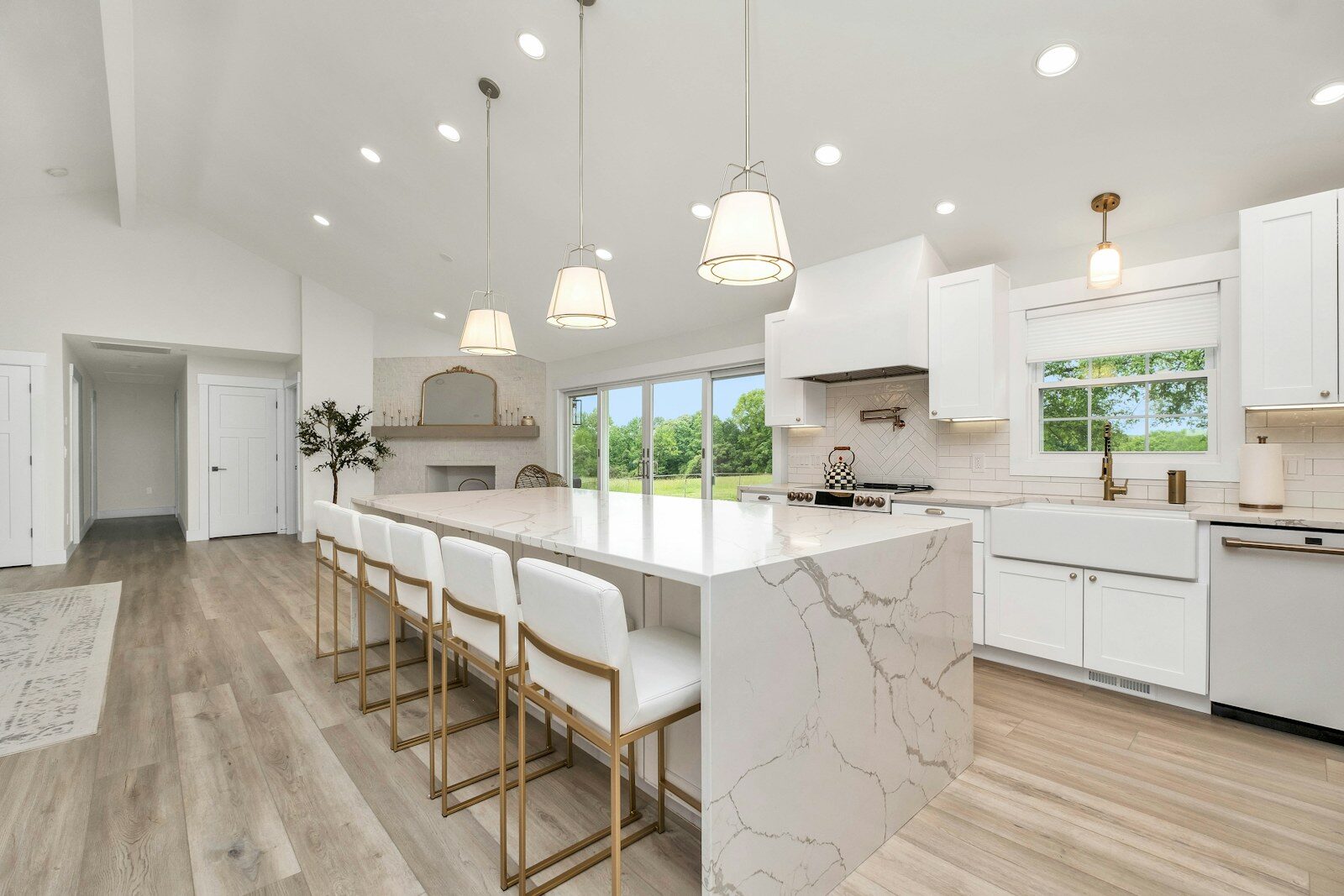
If the worktop run is the workhorse of a kitchen, the island is its centrepiece — the surface guests gather around, breakfast happens on and the whole room is designed to show off. It is also where stone fabrication gets interesting: bigger single pieces, unsupported overhangs, waterfall ends that pour the pattern down to the floor, and vein-matching across faces that meet at a mitre.
We fabricate island worktops in our West Molesey workshop on the same CNC machinery as every kitchen worktop we make, from A-grade slabs of quartz, granite, marble and porcelain. Laser templating is free, fitting is by our own team, and islands are priced within the same honest guide rates — with the instant calculator carrying a dedicated island toggle so you can price yours in a minute.
How big can a kitchen island worktop be in one piece?
Most engineered quartz slabs run to about 3.2m x 1.6m, and jumbo formats slightly beyond — so the majority of Surrey islands fit on a single slab with no joint at all. Natural granite and marble blocks vary, but 3m x 1.8m slabs are common; porcelain sheets reach 3.2m x 1.5m. If your island is larger, we plan the joint position with you at template stage so it lands discreetly.
Single-piece islands are worth designing for: no joint means no resin line across the showpiece surface. If you are still at drawing-board stage, tell your kitchen designer the slab limits above — or send us the plan and we will advise on sizing before you commit to cabinetry.
What is a waterfall end, and what does it cost?
A waterfall end carries the worktop down the side of the island to the floor in one continuous visual pour — the horizontal surface mitred at 45° into a vertical panel so the pattern flows over the edge. As a guide we price waterfall ends at £340 each on top of the island worktop, covering the mitring, bonding and the extra material.
The effect depends on vein continuity, which is why the mitred approach beats a simple butt joint: the stone appears to fold rather than stop. Veined quartz and marble make the most dramatic waterfalls; a honed porcelain waterfall reads sleek and architectural. See how the figures affect a whole kitchen in the costs guide, or add waterfall ends in the estimate calculator.
How much overhang can a breakfast bar have?
In 20mm quartz or granite, up to about 250–300mm of overhang is generally fine unsupported; beyond that we specify discreet steel flat-bar supports let into the cabinetry, and past 400mm you should plan legs, gallows brackets or a structural frame. Porcelain, being thinner, usually wants support sooner. Knee space for comfortable seating is around 300mm, so most breakfast bars sit right at the decision point — which is exactly the sort of thing the laser template visit resolves.
We supply and fit concealed supports where needed, machined flush so you never see them. The rule we work to is simple: a breakfast bar should take a person leaning, a child climbing and a Christmas turkey landing, with margin.
What is book-matching and when is it worth it?
Book-matching uses two consecutive slabs from the same block, polished on opposite faces, so their veining mirrors like an opened book. On an island with a waterfall end — or a large island face seen from the living space — it turns the stone into a symmetrical, almost painterly feature. It is most spectacular in heavily veined marble and the veined premium quartz ranges.
It costs more because it dictates slab purchase: you buy the sequence, not just the area. We will tell you straight when it is worth it — a subtle stone gains little from book-matching, while a dramatic Calacatta or a bold veined quartz gains everything. We arrange slab viewing so you approve the match before a single cut.
Which material is best for a kitchen island?
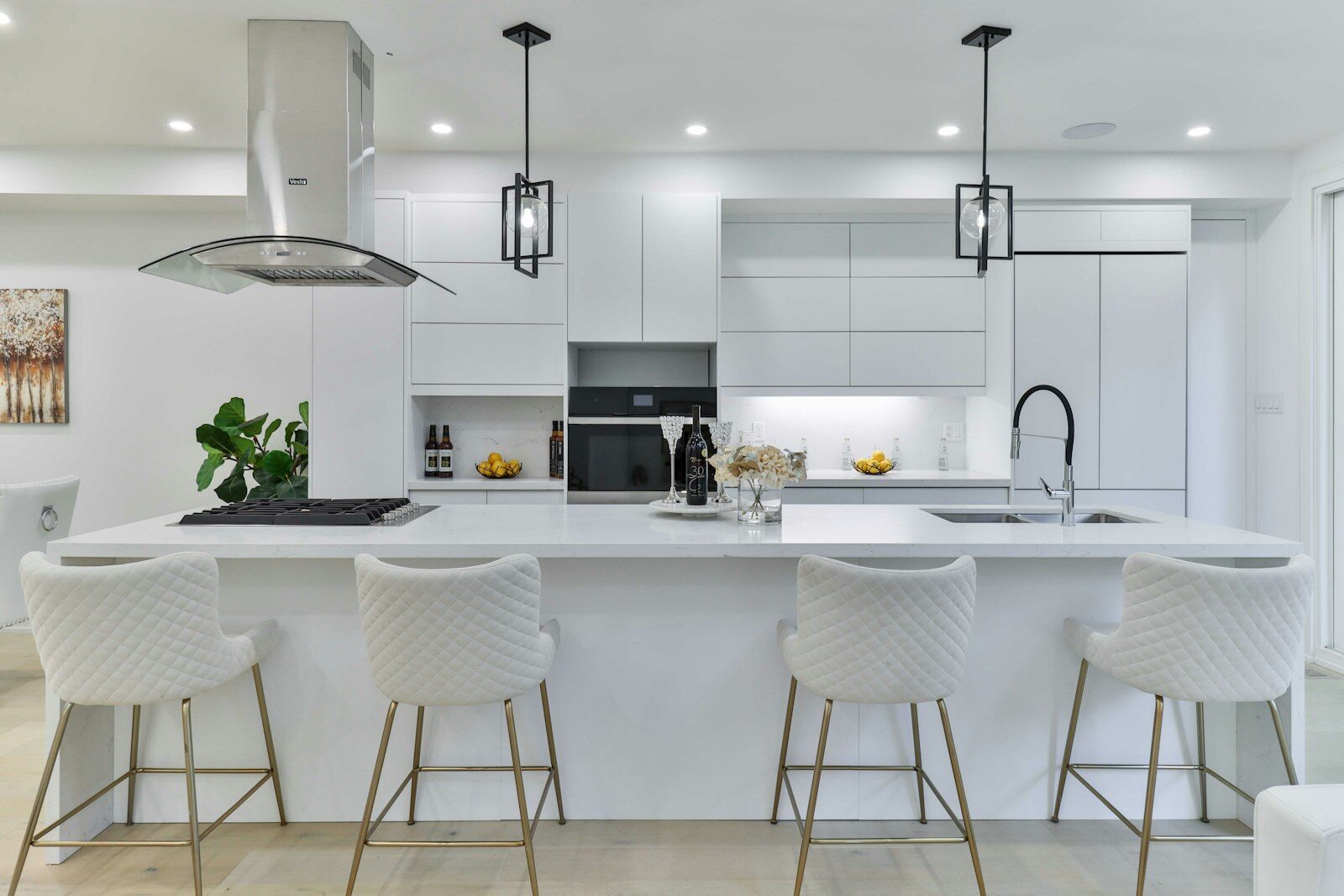
Quartz is the most popular island choice: consistent pattern across big pieces, non-porous against wine and juice spills, and wide availability in 20mm and 30mm. Granite brings natural depth and effortless heat resistance for islands with hobs. Marble makes the most beautiful islands in the business and asks for care in return; porcelain and Dekton suit minimalist schemes and islands that double as serving stations for hot dishes.
If the island contains a hob, think about heat and about joints near the aperture — granite and porcelain are the relaxed choices there. If it is mainly seating and serving, choose with your eyes. Order free samples of your shortlist and look at them in your own kitchen light before deciding.
How are island worktops supported and fitted?
Island worktops sit on the cabinet carcasses like any run, but their size changes the logistics: a 3m single piece in 30mm granite weighs well over 200kg, so we plan access, lifting crew and route at the template visit. Waterfall panels are bonded and mechanically supported at the mitre; overhangs get steel reinforcement as needed; joints — where unavoidable — are bonded with colour-matched resin and pulled tight with setters.
Fitting an island is usually part of the same single installation day as the rest of the kitchen. The fitters dry-lay everything first, check vein flow across joints with you watching, and only then bond. It is your showpiece; you approve the layout before it becomes permanent.
How much does a stone island worktop cost?
As a guide, a 2.4m x 1.1m island comes to roughly £700–£1,100 in essential quartz fitted, £900–£1,400 in premium ranges, and upwards of £1,500 in luxury marble — before waterfall ends at £340 each. Islands are priced by area at the same supplied-and-fitted rates as the main runs, so there is no island premium beyond the extras you choose.
The instant calculator has an island toggle: enter its length and width alongside your main runs and the estimate covers the whole kitchen. As always the figure is a guide, the exact price is fixed after the free laser template, and we beat any written like-for-like quote.
Can an island double as a dining table?
Yes — the island-table hybrid is one of the strongest current kitchen trends, and stone handles it better than any other surface. The usual forms are a lowered table section cantilevered off the island end (supported on a leg or steel frame we specify), or a generous breakfast-bar overhang with proper knee room on two sides. Both give you dining that wipes clean in one pass.
Plan seat spacing at about 600mm per person and remember that table-height sections (750mm) meet worktop height (900mm) with a step the stone must negotiate elegantly — a waterfall panel between levels is the neatest solution we fabricate. Bring the furniture question to template day; it is far easier to resolve in laser measurements than after cabinetry arrives.
Polished, honed or leathered — which finish for an island?
Polished is the showroom default: maximum colour depth, maximum vein drama, easiest to wipe. Honed (matt) finishes are gaining fast on islands because they soften reflections under pendant lighting, feel silky, and disguise fingerprints on dark stones that polish betrays. Leathered granite adds a gentle texture that hides daily life best of all.
Finish changes care slightly: honed marble disguises etching far better than polished; honed dark quartz shows oils more until it builds a routine of normal cleaning. We stock samples in multiple finishes — order them free and audition them under your own kitchen lights, because showroom halogens lie.
What should I plan around an island before templating?
Clearances first: 1000–1200mm of walkway around every working side keeps the kitchen usable by two people; less than 900mm and drawers, dishwashers and humans start to argue. Services second: islands with sinks or hobs need water, waste and power run through the floor before cabinetry arrives, and pop-up sockets need their apertures agreed before we cut. Lighting third: pendants and linear fittings centre on the island, so the island must be positioned finally before the electrician first-fixes.
None of this is stone work, strictly — but all of it determines the stone, which is why we ask about it at quote stage rather than discover it at template. A ten-minute conversation with your kitchen designer and electrician before the laser visit saves the only kind of island mistake that cannot be re-cut: the one in the room layout itself.
When the planning is settled, the stone is the easy part: template, 7–10 days, fitted in a morning. Start the numbers with the island-aware estimate calculator, and see what full kitchens cost in practice in the worktop costs guide.
Guide prices
Guide only — your exact fixed price is confirmed after the free laser template, and we beat any written like-for-like quote.
Island worktop (2.4m × 1.1m, quartz)
£700
Essential-range quartz, supplied & fitted — guide only.
Waterfall end
£340 each
Mitred, bonded and supported.
Breakfast bar overhang supports
£45
Concealed steel flat-bar, per support.
Book-matched slab sequence
POA
Priced on the slabs — we arrange viewing first.
FAQ
Your questions, answered.
Can my island be made without any joints?+
How much does a waterfall end add?+
Can you put a hob in a stone island?+
Will a 300mm breakfast bar overhang need brackets?+
Do islands take longer than normal worktops?+
Related reading
Kitchen worktops
The full guide to materials, pricing and process.
ReadMarble worktops
The book-matching favourite.
ReadQuartz worktops
Consistent pattern across big island pieces.
ReadEdge profiles explained
Pencil round to chunky mitred build-ups.
ReadInstant estimate
Price your island and runs in 60 seconds.
Read
Ready to price your worktops?
Get an instant guide estimate online, or talk it through with the workshop.