Throughout the home
Bathrooms & Vanity Tops
Stone turns a bathroom from fitted to finished. We cut vanity tops, counters and surrounds in marble, quartz, granite and porcelain — including beautiful one-off pieces from stocked remnants.
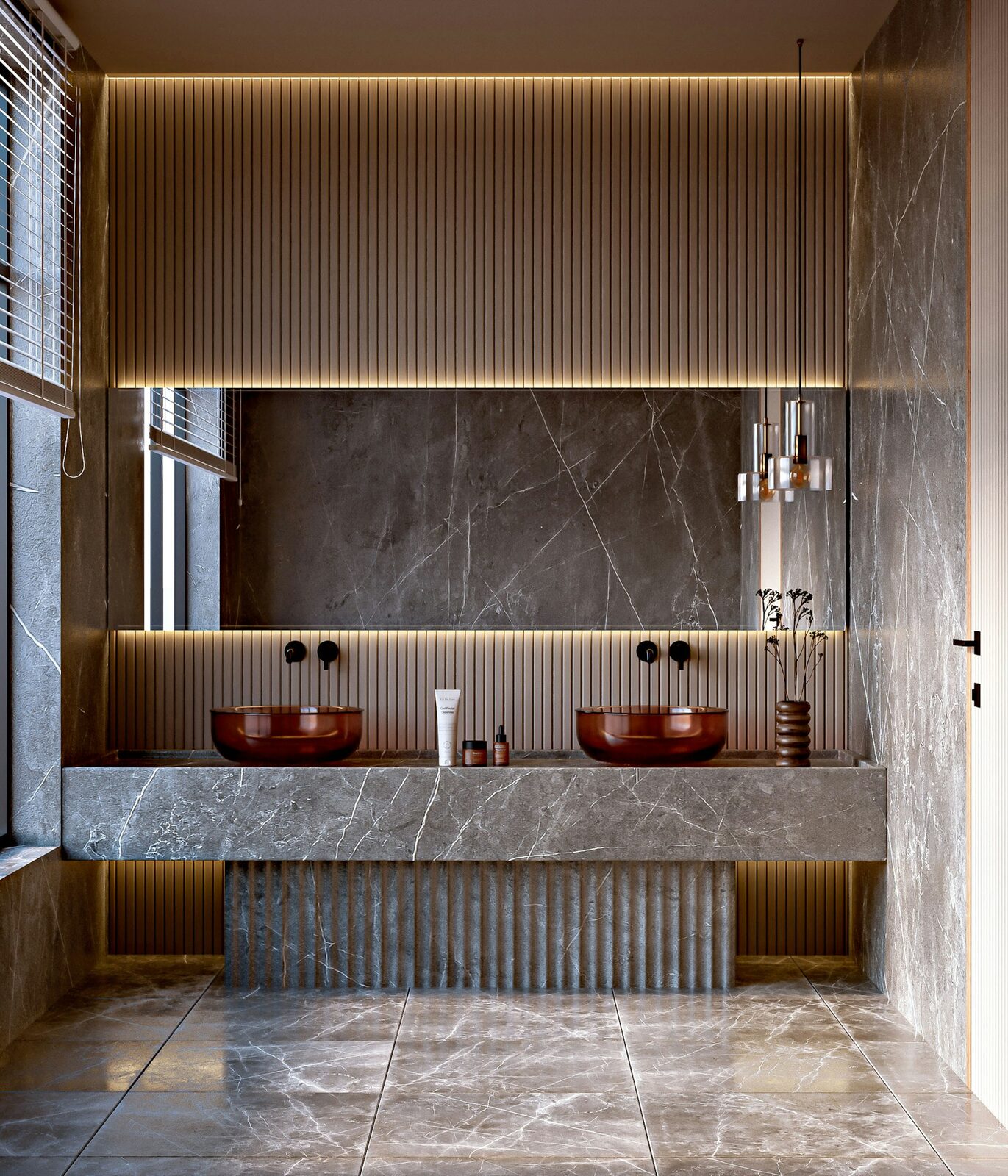
Bathrooms are where natural stone earns its romance back. A marble vanity top, a honed stone counter under a brass tap, a porcelain surround that shrugs off toothpaste and cosmetics — these are small areas of material doing enormous visual work. Because the areas are small, bathrooms are also where stone becomes surprisingly affordable: many of our vanity tops are cut from stocked offcuts and remnants of full-size slabs at a fraction of slab price.
Every piece is laser-templated where fit matters, cut on our own CNC machinery in West Molesey, and polished in-house — with basin cut-outs, tap holes and overflow slots machined exactly to your sanitaryware. We fit across Surrey and South West London, from single cloakroom tops to full bathroom schemes with matching shower walls.
If you are weighing materials, this page covers the honest trade-offs; for whole-home thinking, start at the materials hub or order free samples.
Which stone is best for a bathroom vanity top?
Quartz and porcelain are the most practical vanity materials: both are non-porous, so cosmetics, toothpaste and standing water cannot stain them, and both wipe clean with ordinary soap. Marble is the classic and remains the most beautiful choice — perfectly viable in a bathroom provided it is sealed and you accept gentle patina over the years. Granite sits between: harder-wearing than marble, more natural variation than quartz.
Bathrooms are also lower-risk than kitchens for delicate stone: no hot pans, no red wine, no lemon juice by the chopping board. That is why marble vanities that would terrify people as worktops live long, happy lives beside a basin. Our guide to sealing marble covers the small amount of upkeep involved.
Can I really use marble in a bathroom?
Yes — marble has dressed bathrooms for two thousand years, and a sealed, honed marble vanity top is one of the most forgiving ways to own the stone. The two things to respect are acids and abrasion: some cosmetics, mouthwashes and descalers are acidic enough to etch a polished surface, so a honed (matt) finish, which disguises etching almost completely, is our standard bathroom recommendation.
We seal every natural stone piece before it leaves the workshop and advise a re-seal roughly annually — a five-minute wipe-on job. If a top does pick up marks years later, marble is wonderfully restorable: see re-polishing stone and removing stains.
Undermount, countertop or integrated — how are basins fitted?
All three work in stone, and the choice is style first, cleaning second. Undermount basins sit beneath a polished cut-out so the top wipes straight into the bowl — the most popular and the easiest to live with. Countertop (vessel) basins stand on the stone with just a waste and tap hole, making the slab a plinth for a statement bowl. Integrated stone troughs are a bespoke fabrication we can quote individually.
We machine the apertures on the CNC to the basin manufacturer's template, polish the reveals, and drill tap and overflow holes wherever your brassware demands. Bring the basin model numbers to the quote and everything is cut before fitting day.
What thickness and sizes do vanity tops come in?
20mm is the standard and suits most vanities; 30mm reads more substantial on larger double-basin runs; and mitred build-ups can make a 20mm top appear 60mm or more for a boutique-hotel look. Porcelain runs thinner — commonly 12mm — which suits wall-hung minimalist vanities beautifully.
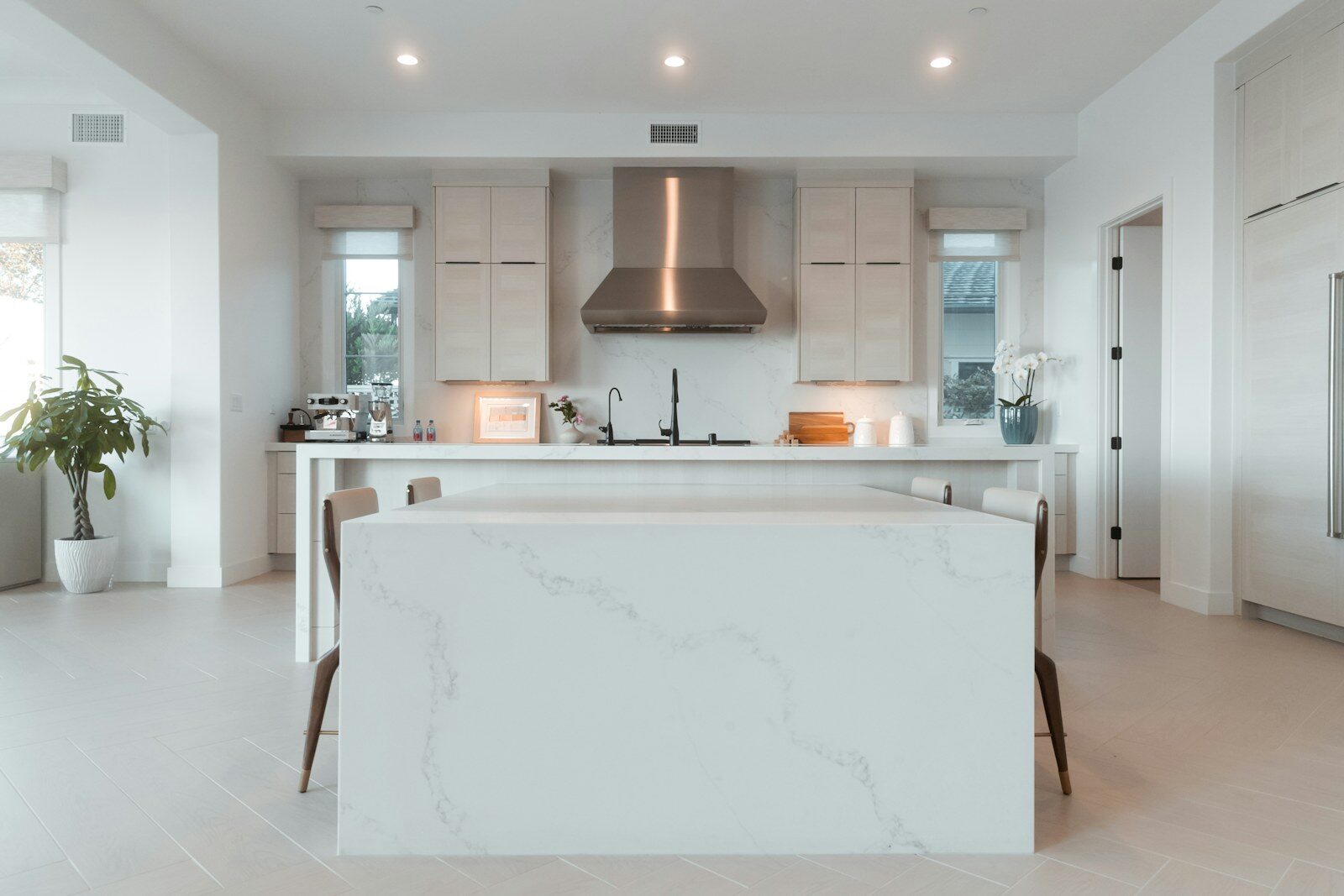
Sizes are whatever your bathroom needs: cloakroom tops from 400mm wide, double-vanity runs over 2m, and L-shaped counters returning along a wall. Because bathroom pieces are small, they are prime territory for remnant stock — a 1.2m vanity top often comes out of an offcut from someone's kitchen island, with the same edge polishing and cut-outs at a much friendlier price. Ask what is in stock when you enquire.
How much does a stone vanity top cost?
As a guide, a single-basin vanity top in quartz starts around £250–£400 supplied with basin cut-out, a marble equivalent £350–£600, and fitted double-vanity runs £500–£1,200 depending on material and complexity — with remnant-cut pieces often 30–50% less than full-slab prices. Templating is free where we fit; supply-only tops are cut to your confirmed sizes.
Every bathroom is quoted individually because sanitaryware, tap positions and upstands vary so much — call 0208 123 3004 or use the contact form with rough dimensions and a photo, and we will price it the same working day. As everywhere: guide prices only, fixed after template, and we beat any written like-for-like quote.
How do I look after stone in a bathroom?
Daily care is a wipe with warm water and a drop of pH-neutral soap — nothing else. Avoid bleach sprays, limescale removers and anything acidic on natural stone (they are fine on porcelain); keep nail varnish remover off every surface; and re-seal natural stone once a year. That is genuinely the whole regime.
The two habits that matter: rinse soap and cosmetic residue rather than letting it sit, and deal with limescale on marble with a damp microfibre cloth promptly instead of a descaler later. If something does go wrong — an etch mark, a chip on an edge — repair and re-polishing is almost always possible in situ.
Can you match shower walls and window sills to the vanity?
Yes, and it is the detail that makes a bathroom feel designed rather than assembled. We cut shower wall panels from the same material as the vanity, run matching window sills and build shelves, niches and kerbs from the same slab family — so the veining and tone carry through the whole room.
Large-format porcelain is especially good for grout-free shower walls, while marble schemes use book-matched panels for a genuinely luxurious wet area. If the pieces are small enough, several can come out of one slab, which keeps a fully coordinated bathroom more affordable than it sounds. Tell us the whole scheme at the quote stage and we will plan the slab accordingly.
Which edge profiles suit vanity tops?
A pencil-round or eased square edge suits most vanities — clean lines, comfortable where hips and hands brush past in a small room, and included in standard pricing. Bullnose edges feel softer and more traditional under hand; mitred build-up aprons turn a 20mm top into a chunky 60mm statement for boutique-hotel bathrooms, priced per metre of build-up.
In tight bathrooms, prioritise rounded profiles on any corner at hip height — a small courtesy your household will appreciate daily. The full profile menu, with honest guidance on cost and cleaning, is in edge profiles explained.
Can stone tops go on wall-hung vanities?
Yes, with arithmetic. A 1200mm quartz top at 20mm weighs around 35–40kg before the basin — well within a properly fixed wall-hung unit's rating, but worth confirming against the manufacturer's stated capacity, which we check at quote stage. For floating shelves-as-vanities and minimalist brackets, 12mm porcelain gives the stone look at roughly half the weight.
The fixing substrate matters more than the stone: wall-hung furniture wants solid masonry or properly noggined stud walls. Flag the construction when you enquire and we will size material and thickness to suit rather than discover the problem on fitting day.
What makes a bathroom scheme feel designed rather than fitted?
Repetition of material in small, deliberate doses. The schemes that photograph best — and feel calmest to live in — use one stone family three or four times: the vanity top, the window sill, a shelf in the shower niche, perhaps a skirting or a shadow-gap detail. Each piece is small, several come from one slab, and the room reads as a single thought instead of a catalogue of products.
The opposite failure is also worth naming: five materials in four square metres. Stone rewards restraint, and our advice at quote stage is often to delete a material rather than add one. Bring the full room plan — tiles, brassware, paint — and we will suggest where stone earns its place and where it does not.
Practically, this is another argument for one fabricator across the scheme: we plan every piece into the slab layout together, cut them in one workshop session, and fit them in one visit. See shower walls and sills for the companion pieces.
Guide prices
Guide only — your exact fixed price is confirmed after the free laser template, and we beat any written like-for-like quote.
Cloakroom / single vanity top, quartz
£250
Supplied with polished basin cut-out — guide only.
Single vanity top, marble
£350
Honed or polished, sealed before delivery.
Double vanity run, fitted
£500–£1,200
Material and complexity dependent.
Remnant-cut vanity tops
30–50% off slab price
Subject to stocked offcuts — ask what is in.
FAQ
Your questions, answered.
Is marble a bad idea in a family bathroom?+
Can you cut the top for my specific basin and taps?+
Do small bathroom pieces come from remnants?+
What is the best low-maintenance bathroom surface?+
Can you fit just a vanity top, without a whole bathroom project?+
Related reading
Shower walls & wet rooms
Grout-free stone and porcelain panels.
ReadMarble
The classic bathroom stone, honestly explained.
ReadPorcelain & Dekton
Zero-maintenance surfaces for wet areas.
ReadSealing marble
The five-minute annual job that protects the stone.
ReadBespoke & remnants
One-off pieces from stocked offcuts.
ReadFree samples
Up to three materials, delivered free locally.
Read
Ready to price your worktops?
Get an instant guide estimate online, or talk it through with the workshop.