Throughout the home
Shower Walls & Wet Rooms
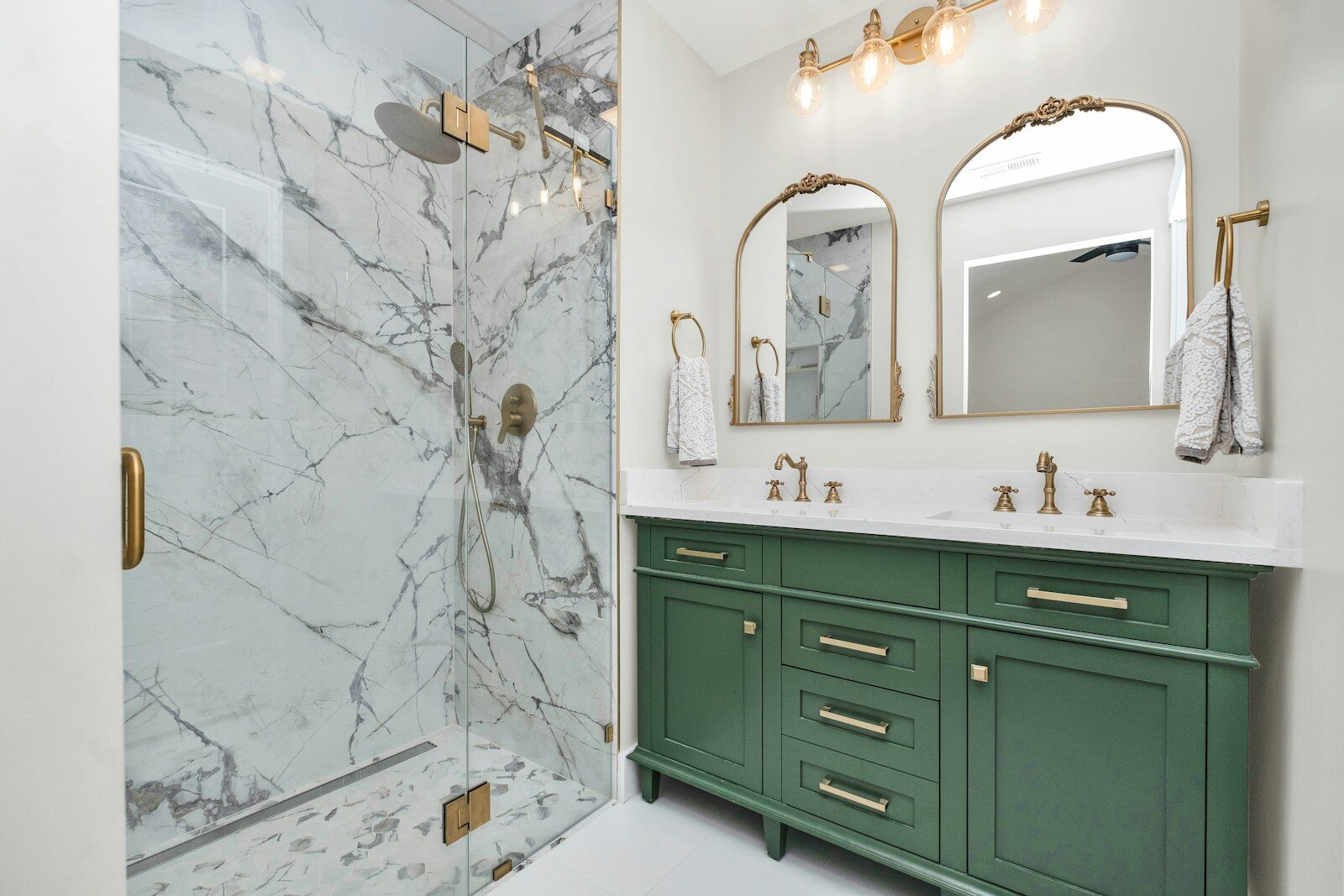
One slab instead of three hundred tiles. Large-format porcelain, marble and quartz shower panels mean grout-free walls that clean in a wipe — cut, book-matched and fitted by our own team.
The single best upgrade in a modern bathroom is removing the grout. Large-format shower panels — full-height pieces of porcelain, marble or quartz cut to the exact walls of your enclosure — replace hundreds of tile joints with two or three sealed junctions, which means nothing to scrub, nothing to discolour and a wall of continuous pattern behind the glass.
We cut shower panels, niches, seats, kerbs and shelf details in our own West Molesey workshop, template the enclosure precisely, and fit across Surrey and South West London — usually as part of a scheme with matching vanity tops. Book-matched marble walls for a statement wet room, or quietly practical marble-effect porcelain: both are a template and ten days away.
Why choose stone panels over tiles in a shower?
Because grout is the weak point of every tiled shower: it stains, it harbours mould, it needs re-sealing and eventually re-doing. Full-height stone or porcelain panels have joints only in the corners, sealed once with colour-matched silicone — so cleaning is a squeegee and an occasional wipe, and the wall looks like a single sheet of material because it is one.
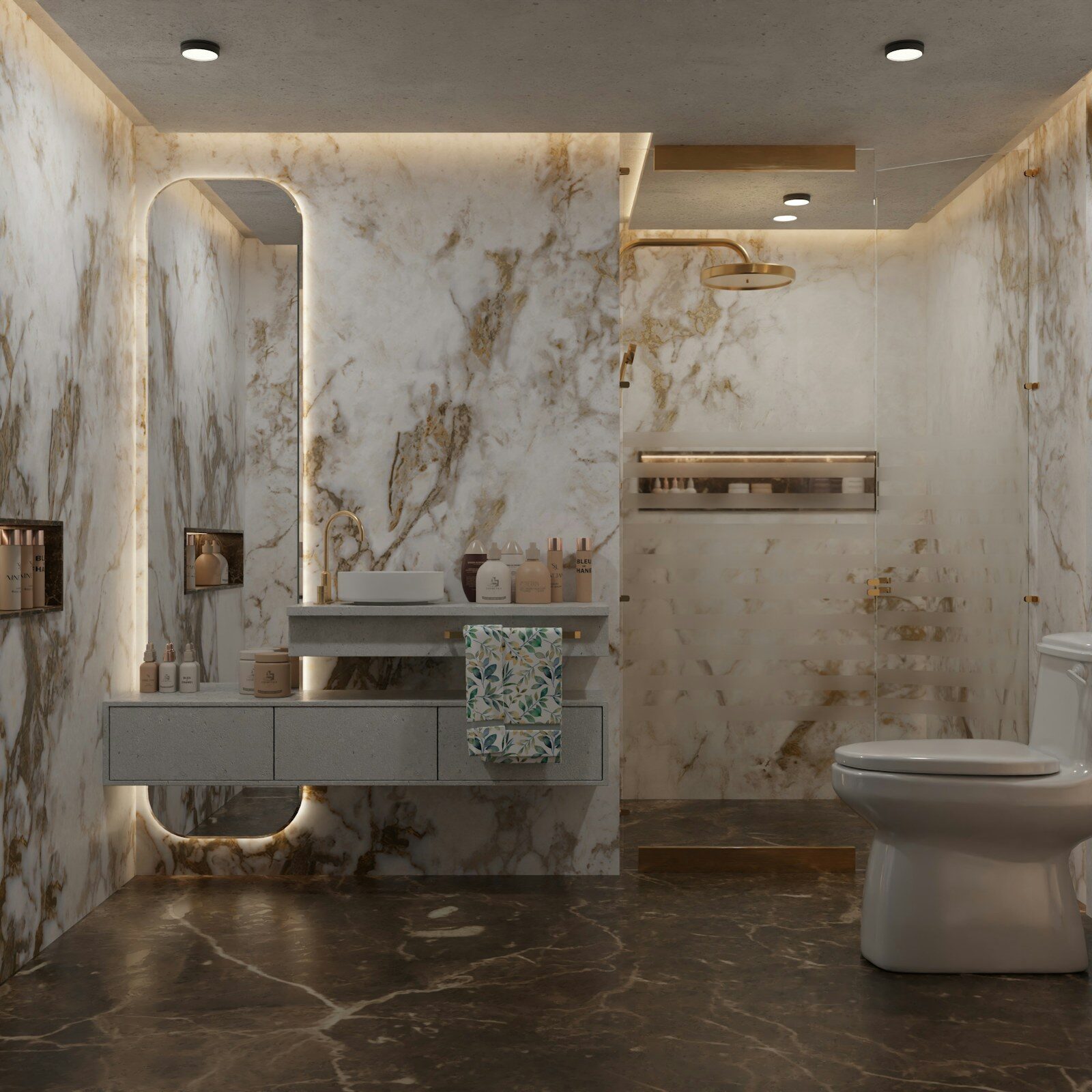
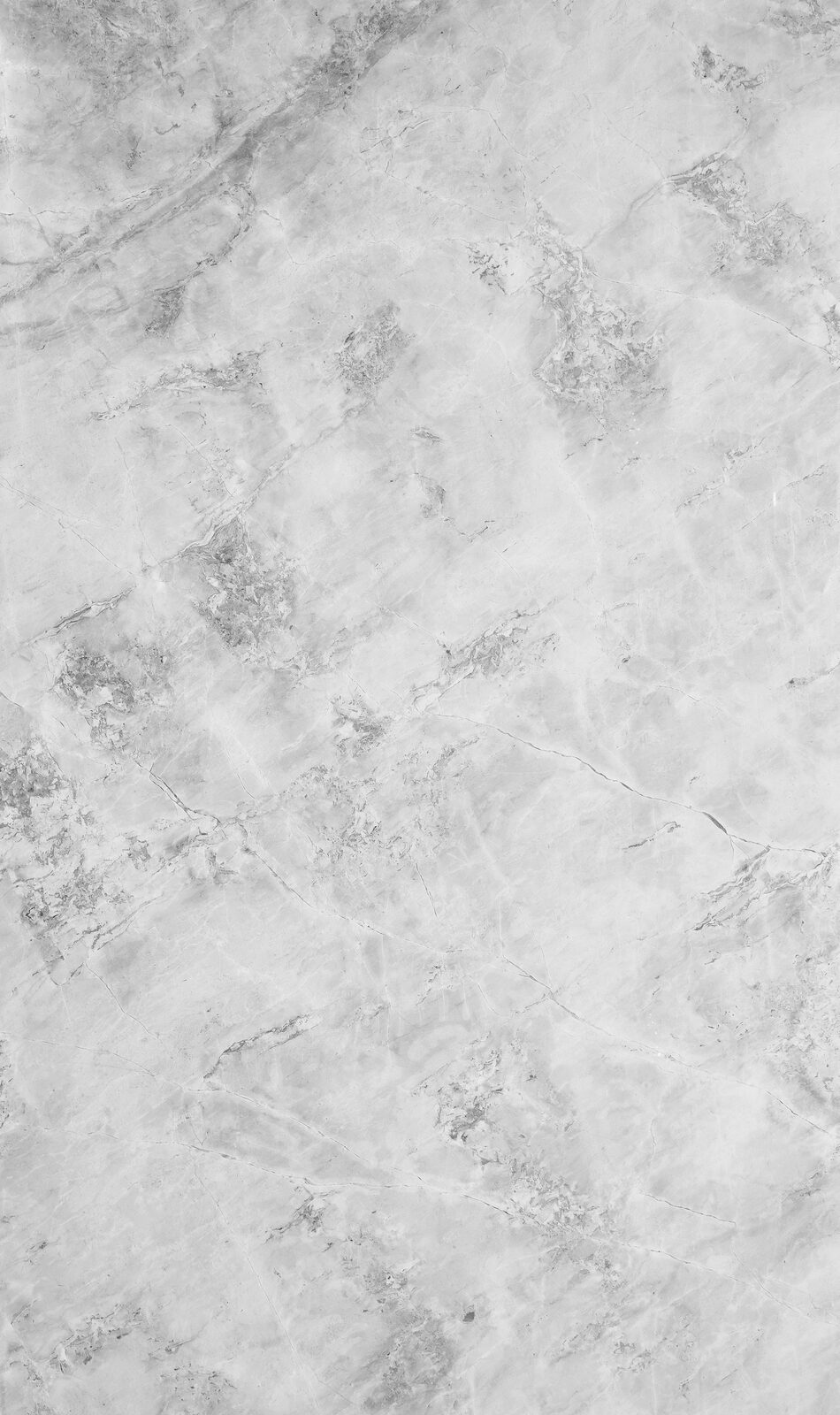
Aesthetically there is no contest: veining flows uninterrupted across the whole wall, and book-matched pairs turn the shower into the best-looking surface in the house. The premium over quality tiling plus labour is smaller than most people expect — often the deciding surprise at quote stage. Price a scheme via the contact page or on 0208 123 3004.
Which material is best for shower walls?
Porcelain is the practical champion: fully non-porous, never needs sealing, immune to every bathroom cleaner, and available in 12mm large formats with extremely convincing marble and stone faces — see porcelain & Dekton. Marble is the luxury choice, viable in showers for millennia, provided it is sealed and maintained; honed finishes age most gracefully. Quartz works too, though manufacturers advise keeping it away from direct prolonged heat sources like steam-room generators.
Our honest default for most families is porcelain walls with natural stone reserved for the vanity, where hands touch it daily and the maintenance ask is tiny. For a full-marble wet room we will spec the sealing and care regime plainly before you commit — sealing guidance here.
How are shower panels fitted and sealed?
Panels are bonded to sound, waterproofed walls — tanked board or rendered masonry — with flexible adhesive, and the joints at corners, tray and ceiling are sealed with colour-matched silicone. The waterproofing layer behind the stone does the structural water management; the stone is the armour and the face. We coordinate with your bathroom fitter so tanking, drainage falls and panel installation sequence correctly.
Cut-outs for valves, outlets and rails are machined on the CNC beforehand to your fitter's positions, with polished reveals. Niches, seats and kerbs are fabricated as stone boxes and bonded in — fully lined, slightly fallen so water drains, and far better-looking than any tiled equivalent.
Can you make shower niches, seats and kerbs to match?
Yes — and matching is exactly the point. Recessed niches are lined in the same stone as the walls with mitred corners so the pattern wraps; bench seats are solid or box-built with a drainage fall; kerbs and thresholds are cut from matching material with softened edges underfoot. These are small pieces, so they frequently come from the same slabs as the walls at little extra material cost.
Sills and other crossover details are covered on the window sills & thresholds page; where a scheme includes the whole bathroom we plan all the pieces into the slab layout together, which is where in-house fabrication quietly saves money.
What does a stone or porcelain shower cost?
As a guide, porcelain shower walls run £180–£280 per m² supplied and fitted, with natural marble panels £300–£500 per m² depending on the stone. A typical 1200 x 900 two-wall enclosure lands between £1,100 and £2,200 in porcelain; a book-matched marble feature wall is quoted on the slabs chosen. Niches add from £180, seats from £240, kerbs from £85.
All figures are guides: the exact price is fixed after the free laser template, and we beat any written like-for-like quote. For a scheme including vanity and sills, send photos and rough sizes through the contact form for a same-working-day response.
How do I keep a stone shower looking new?
Porcelain: squeegee after use if you are keen, any normal bathroom cleaner when you are not — there is nothing to protect. Natural marble: squeegee matters more (it prevents limescale build-up in hard Surrey water), cleaning is pH-neutral soap only, and a re-seal once a year keeps the surface repelling water properly. Never use limescale removers or vinegar on marble — they etch the surface chemically.
If an older stone shower has already dulled or marked, most damage is recoverable: see re-polishing and stain removal. Hard water spotting on porcelain wipes off with standard descaler, which the material does not mind at all.
Guide prices
Guide only — your exact fixed price is confirmed after the free laser template, and we beat any written like-for-like quote.
Porcelain shower walls
£180/m²
Supplied & fitted — guide only.
Marble shower panels
£300/m²
Honed or polished, sealed before fitting.
Recessed niche
£180
Mitred and lined to match.
Bench seat / kerb
£240 / £85
Cut with drainage falls.
FAQ
Your questions, answered.
Are grout-free showers really easier to clean?+
Is marble safe to use in a shower?+
Do you tank or waterproof the walls too?+
Can panels be fitted over existing tiles?+
How long does a shower panel project take?+
Ready to price your worktops?
Get an instant guide estimate online, or talk it through with the workshop.